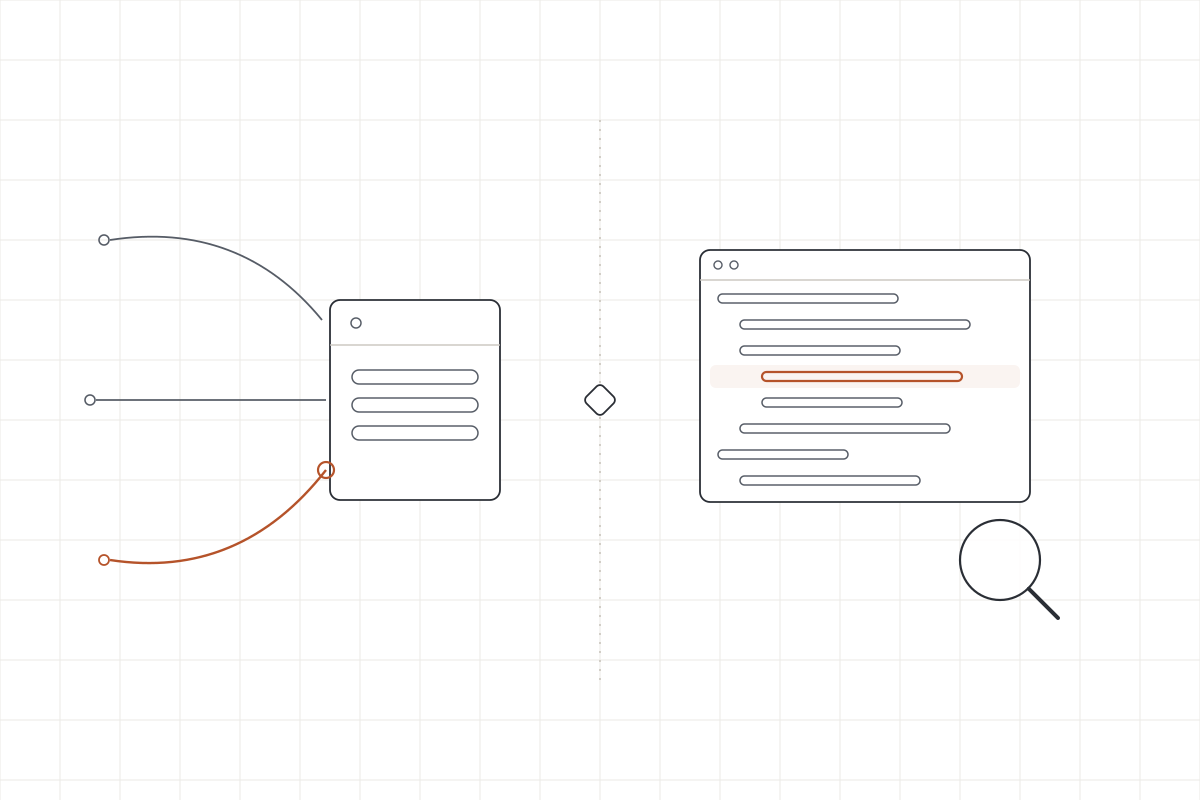
A penetration test attacks your running systems from the outside the way a real attacker would, while a secure code review reads your application’s source code from the inside. They find different problems, and which one you need comes down to one question: does your business build software? If nobody writes custom code for you, there’s nothing to review, and a penetration test is the assessment you are looking for. If you do build or ship software, the honest answer is usually both, at different times. This guide puts penetration testing vs secure code review side by side, in plain English, so you can decide without a sales pitch.
The one-minute difference
| Penetration test | Secure code review | |
|---|---|---|
| What gets examined | Your running systems: networks, servers, apps, logins | Your application’s source code, configuration, and dependencies |
| The viewpoint | Outside in, like an attacker | Inside out, like a very skeptical engineer |
| When it happens | On a live or staging environment, typically yearly or before a launch | During development, or once over an existing codebase |
| Typical findings | Exposed services, weak or reused passwords, misconfigurations, chains of small gaps | Injection flaws, broken permission logic, hardcoded secrets, vulnerable libraries |
| What it misses | Flaws buried in code paths the test never touches | Problems that only exist in the deployed environment |
| Who needs it | Almost any business with systems on a network | Businesses that build or heavily customize software |
Security people call these black box and white box testing: the tester either works without inside knowledge, the way an outsider would, or works with full access to the internals. You do not need the vocabulary to make the right call. You need to know what each one can and cannot see.
What a penetration test finds
A penetration test measures your environment as it actually runs. The tester probes what is reachable, tries real attack paths, and chains small weaknesses together the way an actual intruder would: a stale account here, a reused password there, a misconfigured service that turns a foothold into a problem. The output is proof of what worked and a prioritized fix list. If the concept is new to you, our guide to what a penetration test is covers it end to end, and our external testing service is the most common starting point.
What a pentest cannot do is see inside your code. If your application has a flaw in a path the test never exercises, a payment edge case, an admin function nobody linked to, logic that only breaks under a specific sequence, the test can walk right past it. The tester sees what the running system shows them.
What a secure code review finds
A secure code review reads the source: the code your team wrote, the configuration around it, and the open-source libraries it depends on. It combines automated scanning with a human reading the high-risk paths, and it surfaces the problems that live in the code itself: input that can be turned into commands, permission checks that can be sidestepped, credentials committed into the repository, a stale library with a known flaw. We cover the full process in what is a secure code review.
Its blind spot is the mirror image of the pentest’s. A review sees the code, not the deployment. A perfectly reviewed application can still sit behind a misconfigured firewall, an exposed admin panel, or an account with a password from 2019. The code being sound says nothing about the environment it landed in.
Which one your business actually needs
This is the part most comparisons dodge, so here it is plainly.
- You do not build software. Your line-of-business apps are bought, your website is a standard platform, nobody commits code for you. You have no code to review, and a code review would be money spent on the wrong question. An external penetration test of your environment is the right tool.
- You ship software to customers. A SaaS product, a mobile app, a portal your clients log into. You need both, and the order matters: a secure code review as the code is built or before a major release, then a test of the running application before or shortly after it goes live. Our web application testing covers that second half.
- You customize heavily. Custom integrations, internal tools, scripts wired into sensitive data. You are in between: a focused review of the custom pieces plus a standard pentest of the environment usually covers it without paying for either at full scale.
If a customer questionnaire or a compliance framework is what raised the question, read what it actually asks for. Cyber-insurance applications usually ask for penetration testing by name. SOC 2 does not name it, though auditors commonly expect some form of security testing to satisfy the monitoring criteria. Secure development practices come up when you sell software, not when you merely use it.
Does a penetration test include code review?
Usually not, and it is worth being clear about because the terms get blurred in sales conversations. Most penetration tests are performed without source code access. Even a web application pentest, which goes deep on one app, tests the running application rather than reading its source. Some firms offer code-assisted testing as an add-on, where the tester has the source open while attacking the live app, and it is genuinely useful, but it is something you agree on in scoping, not something to assume. If a proposal says “application testing,” ask whether anyone will actually read the code. The answer changes what you are buying.
The reverse is also true: running a scanner over source code is not a penetration test, no matter what the report cover says. Tools find the known patterns. A person finds the chain of small things that actually gets someone in.
Cost and timing, in plain terms
Penetration testing is the more standardized purchase. Scope drives price, and we publish our numbers openly on our pricing page, with the market context covered in our guide to what a penetration test costs. A typical SMB engagement runs about one to two weeks end to end.
Secure code reviews are priced by the size and complexity of the codebase, so quotes come after a scoping look at the repository, not before. A focused review of one application’s critical paths is days of work; a large legacy codebase is weeks. For a business that ships one product, the review and the pentest often end up in the same general price neighborhood, but treat that as a starting expectation, not a promise. Anyone quoting either one without scoping first is guessing with your money.
Frequently asked questions
Does a penetration test include reviewing the source code?
Usually not. Most penetration tests, including web application tests, work against the running system without source access. Code-assisted testing exists as an add-on some firms offer, but it has to be agreed in scoping. If it matters to you, ask directly whether a human will read the code.
Should code review come before or after penetration testing?
Before, when you have the choice. Reviewing code during development catches flaws while they are cheap to fix, and the penetration test then validates the running system before or shortly after launch. For an existing application that has had neither, doing the pentest first tells you what is exposed today.
Do I need a secure code review if I already get penetration tests?
Only if you build or customize software. If you do, yearly pentests alone leave code-level flaws unexamined, and adding a review of the high-risk code closes that gap. If you do not write code, your pentests are covering the right ground already.
Is one better than the other?
Neither is better; they answer different questions. The code review asks whether the software was built safely. The penetration test asks whether the whole environment, software included, holds up against a real attacker. A business that ships software eventually wants both.
The bottom line on penetration testing vs secure code review
A penetration test checks the environment you run; a secure code review checks the software you build. If you build nothing, test what you run and skip the review without guilt. If you ship software, plan for both on a sensible cadence. And if you are staring at an insurance questionnaire or a customer security review trying to work out which box it is really asking you to tick, send it our way. We’ll tell you plainly what it requires, what it doesn’t, and what a right-sized engagement looks like, with a fair, fixed quote. Request a quote.
Want to know where you stand?
Tell us a little about your business and what is prompting the test. We will come back with a fair, fixed quote.
Request a quote